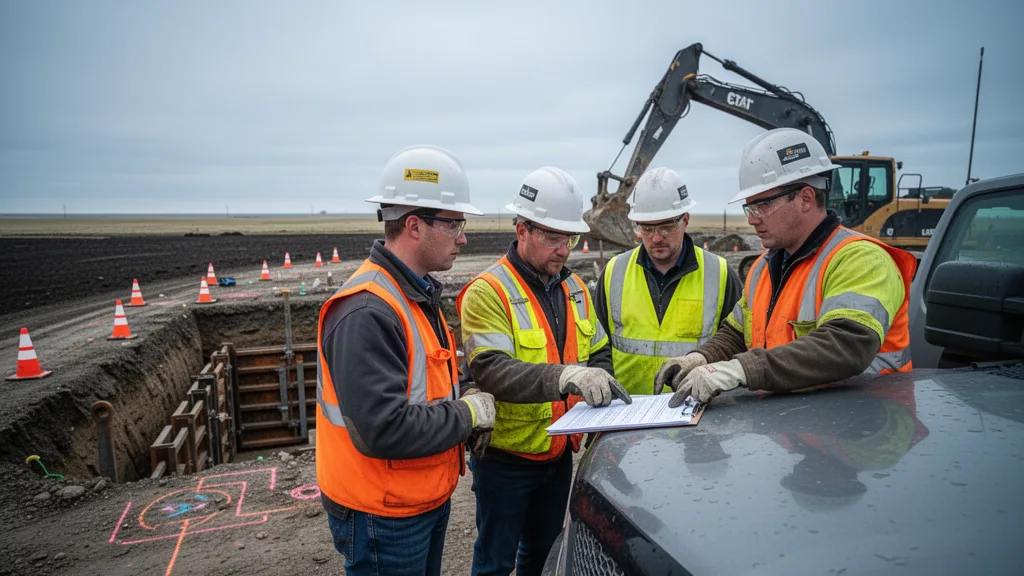
Safety is the schedule.
Nothing on our sites moves faster than the hazard assessment. Twenty-two years in live utility corridors is why.
Safety is not a department. It is how the work is planned.
Safety-led planning means the hazard assessment precedes the schedule, not the other way around. Before a crew mobilises we have the locates, the traffic accommodation plan, the permits and the site-specific orientation in hand. The fastest way to lose a week is to start a shift that has to be stopped.
Every worker on an ASI site holds stop-work authority, and it is exercised without needing a supervisor's permission or approval after the fact. Our safety program strictly complies with Alberta OHS legislation across all our provincial work sites. A crew that stops work over an unmarked line or a failing trench wall has done its job correctly. Nothing we are building is worth more than the person building it.
Accountability runs in both directions. Field-level hazard assessments are signed by every worker on site and reviewed by the superintendent; incidents and near-misses are reported, investigated to root cause and closed out at management level. Our program is audited by third parties rather than self-certified, because a prime contractor should not have to take our word for it.
Six controls that run on every site.
Daily safety briefings
Every active site opens the shift with a documented field-level hazard assessment, signed by every worker present. Conditions change daily in a live corridor; the paperwork changes with them.
Zero-tolerance drug and alcohol policy
A zero-tolerance policy applies to every ASI employee and every subcontractor on our sites, with testing per client and site requirements. There is no version of this we negotiate.
PPE program with regular audits
Task-appropriate PPE is issued, inspected and replaced on our account, not the worker's. Compliance is audited on unannounced site visits rather than assumed.
Ongoing training and recertification
Tickets and competencies are tracked to expiry and renewed before they lapse: ground disturbance, confined space, fall protection, first aid and equipment-specific certification. Records are current and produced on request.
Incident reporting and root-cause analysis
Incidents and near-misses are both reportable. Each is investigated to root cause, and the corrective action is distributed to every crew rather than filed with the one involved.
Third-party safety audits
Our program is audited externally on a recurring cycle. Findings and corrective actions form part of the prequalification package we provide to clients.
Certified, audited and current.
Corning Certified Installer
CORNING INCORPORATEDFOA Corporate Affiliate #0204
FIBER OPTIC ASSOCIATIONAlberta OHS Compliant
GOVERNMENT OF ALBERTAWCB Alberta Clearance
WCB ALBERTACOR / SECOR
ALBERTA CONSTRUCTION SAFETY ASSOCIATIONISNetworld
ISN SOFTWARE CORPORATIONAvetta / ComplyWorks
AVETTAMeasured, not asserted.
Every shift, in order.
- 01
Pre-job hazard assessment
Documented before the first task of the shift and signed by every worker on site.
- 02
Locates and daylighting
Locate tickets verified in the field and utilities exposed by hydrovac before any mechanical excavation.
- 03
Traffic accommodation plan
Signage, taper and pedestrian access set to municipal standard before the work zone opens.
- 04
Tailgate meeting
Scope, sequence, hazards and stop-work expectations confirmed with the whole crew.
- 05
Permits
Ground disturbance, confined space and client work permits in hand and posted on site.
- 06
Post-job inspection and restoration
Surface reinstated, site cleaned and the work inspected before the crew demobilises.